While trekking through the villages along the Manaslu Circuit in Nepal, prayer flags aren’t the only thing you will see, you will also notice a lot of firewood.
It is stacked beside houses, under roofs, along stone walls and sometimes in separate storage areas. In some villages, there are large piles of wood outside homes and lodges.
If you are doing the Manaslu Circuit trekking route for the first time, you may not think much about it, you saw it, walked passed it while continuing with the trek enjoying the view of the mountains.
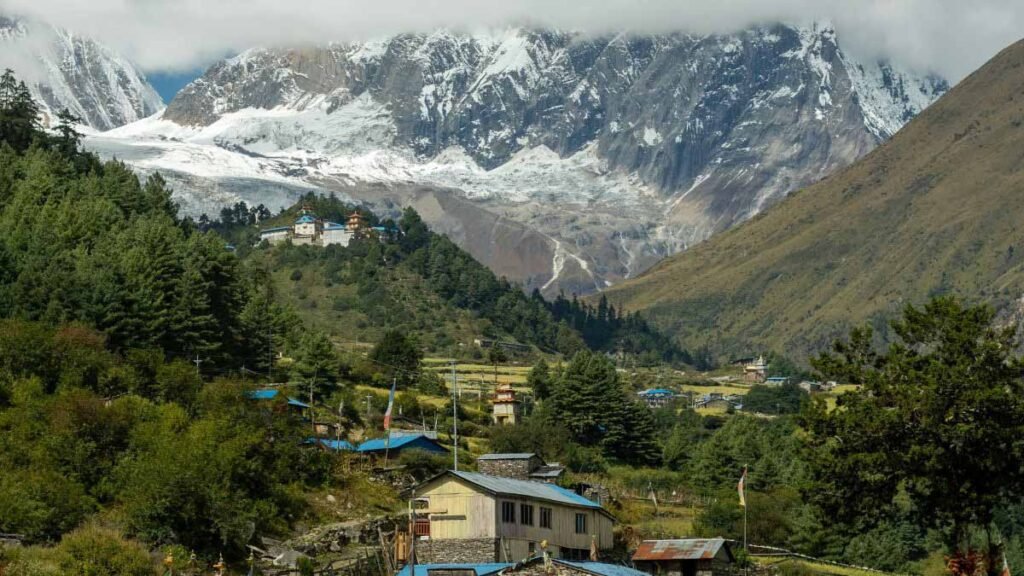
But there is a reason why so much firewood is stored around the houses. The Manaslu region is remote, and in many of the villages, firewood has traditionally been an important source of fuel for cooking and heating.
The Manaslu Conservation Area covers 1,663 sq km and is home to around 9,000 people. Local communities depend on agriculture, livestock, tourism and natural resources from the surrounding area, including firewood and timber.
So those piles of wood are not just part of the scenery. They are part of how households manage their daily needs, particularly in a place where getting fuel is not as simple as going to the nearest shop.
Why Do People Need So Much Firewood?
The answer becomes easier to understand once you start gaining altitude.
The Manaslu Circuit begins in the lower Budhi Gandaki valley and gradually climbs through villages such as Namrung, Lho and Samagaun before reaching Samdo and eventually the Larkya La Pass at more than 5,000 metres.
The climate changes quite a bit along the way. At higher elevations, temperatures are much lower, particularly during winter. Heating is not just about keeping a room comfortable.
Fire is also needed for cooking and hot water, especially in places where other sources of fuel are difficult or expensive to obtain.
A study conducted in Samagaun found that firewood was the main source of cooking energy among the households surveyed. At the time of the study, 81 percent of the 42 households used traditional cooking stoves, while the remaining 19 percent used improved stoves.
The study was carried out in 2012, so these figures should not be treated as the current situation in every household in Samagaun. But they give you an idea of how important firewood has been in the village.
And when you walk through Samagaun and see the piles of wood outside houses, the reason becomes a little clearer.
How Much Wood Does a Household Need?
Probably more than you would expect.
The same Samagaun study estimated that households using traditional cooking stoves consumed an average of around 62.7 kg of firewood per day. Households using improved stoves consumed around 43.6 kg per day.
Those numbers are from a specific study and should not be taken as a standard amount for every house in Manaslu. But even then, it gives some perspective.
If a household needs that much fuel, keeping a small pile of wood outside the house obviously isn’t going to be enough.
Another study from Chhekampar in the Tsum Valley looked at the time people spent collecting firewood. The difference between lower and higher elevations was quite significant.
For households using traditional stoves, the study recorded an average collection time of around three hours at lower elevations, 4.3 hours at middle elevations and 16.8 hours at higher elevations.
That is a lot of time just to collect firewood. The study also found that an average bundle of firewood weighed around 40 kg.
So the next time you see someone carrying a large bundle of wood along a mountain trail, it is worth remembering that this is not a light load.
When Is the Firewood Collected?
Firewood cannot simply be collected whenever a household runs out. Weather and access become important, particularly at higher elevations.
The Chhekampar study found that households mainly collected firewood around April and October. The wood was then stored for use during the year.
This makes sense when you look at the conditions in the higher villages. During winter, snow and cold weather can make movement more difficult. Some of the higher settlements also have a much shorter season when regular activities are easier to carry out.
Having firewood already stored near the house means that people don’t have to go looking for fuel every time they need to cook or heat the house.
This is one reason you will often see the wood arranged neatly and kept under some sort of cover.
Where Does the Firewood Come From?
This is another interesting part of it.
People do not simply cut down trees in the forest to get firewood. A study carried out in Samagaun found that households collected firewood from the protected forest areas around the village, particularly Pangshar and Kermo.
The study noted that dry fodder and timber were allowed to be gathered rather than cutting down trees.
The same study recorded Bhojpatra, Rhododendron campanulatum (Chimal) and juniper among the species used as firewood.
The research was based on fieldwork carried out in 2012, so it should not be taken as a description of current practices everywhere in Manaslu, but it gives a useful picture of how firewood was being collected in Samagaun.
There Is an Environmental Side to It
It is easy to look at the firewood piles and think only about the practical side of things. But burning large quantities of wood has its own problems.
The Samagaun study found that traditional cooking stoves produced considerably more indoor air pollution than improved stoves. The researchers recorded average particulate concentrations of 2,866 μg/m³ for traditional stoves compared with 1,333 μg/m³ for improved stoves.
The study also found that improved stoves used less firewood and produced lower calculated carbon emissions. This is one reason why improved cooking stoves and alternative energy sources are useful in places like Manaslu.
The National Trust for Nature Conservation has worked on alternative energy and improved cooking technologies in the Manaslu Conservation Area, along with projects involving solar power and micro-hydropower.
So the large piles of firewood you see on the trail are also part of a much wider question about energy use in the mountains.
Does This Matter to Trekkers?
You don’t really need to do anything special when you see firewood stacked outside a house. But I think it is useful to understand what you are looking at.
On the Manaslu Circuit, you spend around two weeks walking through villages and seeing how people live along the trail.
There is much more to notice than the mountains. You see animals around the houses, food and other supplies being stored, goods being carried along the trail, and firewood stacked outside homes before the colder months.
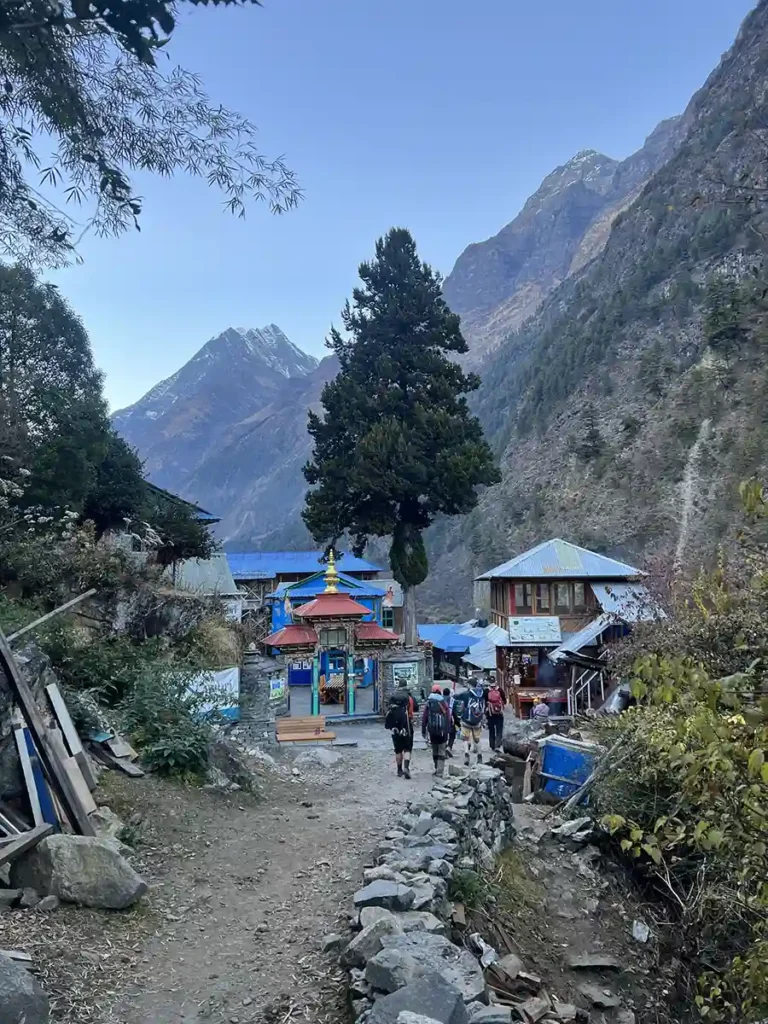
Firewood is one of those things. When you walk into a teahouse and see a stove burning, it is easy to think only about getting warm or having your dinner cooked. But that firewood has to be collected, carried back to the village and stored somewhere before it can be used.
And at higher elevations, that can involve considerably more time and effort than you might expect. It also helps explain why responsible tourism matters in a place like Manaslu.
Look at the Small Things
You will notice firewood stacked beside a house. You might see hay stored on a roof, tools kept outside a doorway or food being dried in the sun.
These are very ordinary things, but they give you a better idea of what daily life looks like in the villages along the route.
So the next time you are trekking in Nepal through a Manaslu village, have a look at those firewood piles. You don’t need to stop and study every one of them. Just knowing why they are there makes you notice the trail a little differently.
The mountains are obviously the main attraction of the Manaslu Circuit. But once you start paying attention to these smaller details, you also start appreciating how much planning and work goes into everyday life at high altitude, making your trekking experience more meaningful.